
Realogistics Completed Guangxi-Vietnam Anchor Bolt Transport

I. Project Overview
• Transport Route: China Guangxi (Factory) Pingxiang Friendship Pass (Smart Port) Vietnam Lang Son (Xuan Cuong Yard) Vietnam Tra Vinh Province, Duyen Hai Project Site.
• Scope of Service: Full logistics under DAP (Delivered At Place) terms, including loading plan design, export customs clearance, cross-border road transport, border transshipment/reloading, assistance with Vietnam import clearance, and terminal delivery.
II. Cargo Details
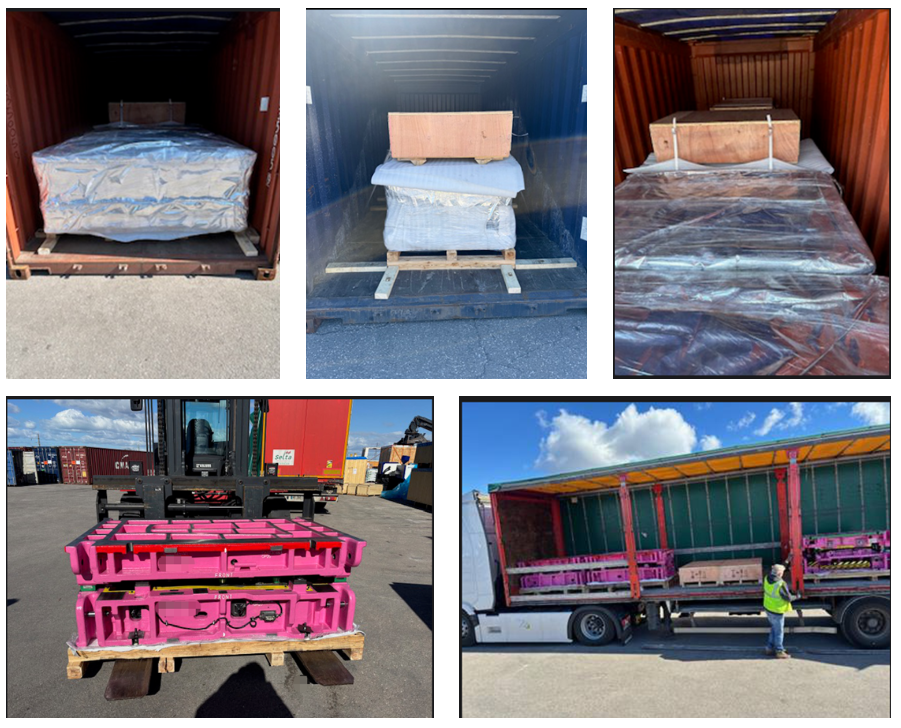
The cargo consists of core components for large-scale wind power and infrastructure projects, characterized as "Heavy, Long, and Loose":
• Core Cargo: Anchor Plates, Anchor Bolts, High-strength bolt assemblies.
• Key Parameters:
• OOG (Out of Gauge)/Overweight Items: Anchor Plate dimensions: mm; Gross Weight per piece: 5.42 tons.
• Small Accessories: Includes 371 items such as Dacromet nuts and washers; high-precision accessories requiring wooden crate packaging for moisture protection.
• Scale: Total quantity: 113 pieces; Total weight: 256.1 tons, requiring multi-truck batch transport.
III. Core Challenges & Operational Difficulties
1. The "Gap" in Weight Limit Standards
• Challenge: The weight limit for an 18-meter flatbed truck in China is approx. 32-33 tons, whereas Vietnam strictly limits road transport to 30 tons. If loaded according to Chinese standards, vehicles would face heavy fines or forced unloading/reloading upon entering Vietnam, leading to uncontrollable costs.
2. "Asymmetry" in Declaration Rules
• Challenge: Export at Friendship Pass (Guangxi) requires "One Truck, One Bill" (except for indivisible equipment); however, Vietnam Customs allows "One Bill, Multiple Trucks" for consolidated declarations (up to 20 line items). Mismatched documentation could result in clearance failures on the Vietnam side.
3. The "Time-Limit Circuit Breaker" in Border Clearance
• Challenge: The release code for the queuing system at Friendship Pass (Lane 2) is valid for only 24 hours. If the vehicle enters the queue but the Vietnam side fails to provide the "Vietnam Code" (acceptance declaration code) in time, the vehicle is removed from the system and must re-queue, incurring demurrage and delays.
IV. Realogistics Professional Solutions
1. Reverse-Engineering Loading Method (Balancing Limits & Cost)
• Strategy: Abandoning the standard "Full Load Principle," we used the Vietnam 30-ton limit as the "red line" to reverse-engineer the domestic loading plan.
• Execution: We pre-audited the packing list before factory shipment, strictly controlling cargo weight per truck to under 30 tons. Although this resulted in a slight underload for the domestic leg, it completely eliminated the risks of foreign fines and secondary reloading, achieving optimal total cost.
2. "Dual-Track" Document Management System (Resolving Declaration Conflicts)
• Strategy: Implementing parallel management for export and import documentation.
• China Leg: Prepare export declarations based on "One Truck, One Bill" to satisfy Chinese Customs regulations.
• Vietnam Leg: Assist the client in consolidating multiple trucks to declare under "One Bill, Multiple Trucks."
• Key Control Point: Ensure the information flow on the Certificate of Origin FORM E matches the Vietnam Import Declaration exactly (rather than the China Export Declaration) to guarantee the client successfully receives 0% tariff treatment.
3. "7+24" Dynamic Clearance Coordination (Mitigating Time Risks)
• Pre-declaration: Utilizing the "7-day Advance Declaration" policy to release documents before the trucks arrive.
• Node Control: Establishing a "Shuttle-Declaration" linkage mechanism. Once our transshipment (shuttle) is complete, vehicle info is immediately pushed to the Vietnam side for declaration. A dedicated team monitors the system and only arranges for vehicles to enter the Lane 2 queue after obtaining the "Vietnam Code," ensuring a 100% pass rate within the 24-hour validity window.
4. Redundant Route Survey & Risk Control
• Route Backup: The primary route is the Nanning-to-Ho Chi Minh Highway. Backup routes were planned to handle potential disruptions during the Vietnamese rainy season or landslides.
• Compliance Details: Fumigation for wooden packaging was arranged in advance to prevent rejection at the border due to phytosanitary issues.
V. Industry Knowledge Extension
1. Responsibility in DAP Terms
In cross-border land transport under DAP terms, it is crucial to clearly define who bears the costs for "Lifting, Transshipment, and Drayage." particularly during border vehicle exchange. Demurrage charges are usually borne by the party causing the delay, so defining the cause of delay (Lack of trucks? Missing documents? Expired codes?) is critical.
2. Friendship Pass: "Border Transshipment" vs. "Through Truck"
• Border Transshipment: China truck to border Crane lift to Vietnam truck Vietnam truck departs. Pros: Flexible capacity matching, controlled costs. Cons: Added risk during handling.
• Through Truck: China truck drives directly to the Vietnam yard. Pros: Reduced cargo damage risk. Cons: Requires international transport permits and incurs higher foreign demurrage/registration fees.
• This project selected the Transshipment mode, combined with a precise loading plan, for better cost-performance.
3. FORM E Consistency
The "Shipment Date" on the FORM E must closely align with the actual border crossing date. If border congestion causes the actual crossing to be significantly later than the document date, destination customs may question the validity. Therefore, a "time window" must be reserved, or the certificate should be issued rapidly after the crossing date is confirmed.
VI. Project Summary
Faced with the complex regulatory environment and hardware limitations of the China-Vietnam border, Realogistics did not stop at simple "transport execution." Instead, through front-loaded compliance planning (reverse weight calculation), precise document segmentation (dual-track declaration), and real-time border linkage mechanisms, we successfully resolved the twin challenges of weight discrepancies and clearance timeliness.
Core Value Delivered:
• Zero Fines: Avoided all overload risks in Vietnam through precise weight control.
• Zero Tariff Obstacles: Perfect document matching ensured the effective use of FORM E.
• Visualized Delivery: Achieved clear transfer of cargo ownership rights from the factory weighbridge to the Vietnam POD (Proof of Delivery).
Contact Realogistics today for a quick quote!
WhatsApp: +85269373282
Email: tony.wu_hkg@realogistics.net
Skype: tony.wu_hkg@hotmail.com
Realogistics International Group Co., Ltd. Established in 2012 in Hong Kong.


Comments